Contracts with Hostage-Takers Probably Not Enforceable

All-around stand-up guy, Jesse Dimmick

Two years ago, fugitive murder suspect Jesse Dimmick kidnapped newlyweds Jared and Lindsay Rowley after bursting into their home on a Saturday morning.

Now, he’s suing them for $235,000.

Dimmick contends in the breach of contract suit that after he entered the couple’s home in September 2009, they reached a legally binding, oral contract that they would hide him for an unspecified amount of money.

“Later, the Rowleys reneged on said oral contract, resulting in my being shot in the back by authorities,” Dimmick wrote in a notarized legal document, which said he was filing the counterclaim in response to a suit the Rowleys filed against him in September.

Ironclad reasoning, right? Not exactly, wrote the Rowleys’ attorney in their motion to dimiss. Kevin Underhill summarizes:

First, there was no agreement. Second, if there was an agreement, there was no meeting of the minds on the amount of money (Dimmick admitted the “offer” was for “an unspecified amount”), and so no binding contract. Third, agreements made at knifepoint are, you may be surprised to learn, not enforceable as they are made “under duress.” Finally, a contract to do something illegal (e.g. hide a fugitive) is also not enforceable.

Read the pleadings here.

Via Lowering The Bar.

CA Appellate Court Affirms: “Driving” Includes Stopping and Being Stopped at a Red Light

A traffic officer observed Carl Nelson using his wireless telephone with his hands as he paused his car at a red traffic light. The officer cited Mr. Nelson for infraction of Veh. Code §23123(a). Mr. Nelson contested the citation on the basis that he had only been using the phone while he was stopped at the signal to check his e-mail. Mr. Nelson contended that he was not “driving” as required by §23123(a) pursuant to Mercer v. Department of Motor Vehicles (1991) 53 Cal.3d 753. The trial court found Mr. Nelson guilty.

The court of appeal affirmed, holding that Mr. Nelson was “driving” within the intended meaning of §23123(a).

The court acknowledged that the §23123(a) terms “drive” and “while driving” are ambiguous as to a driver’s fleeting pauses as he drove on public roadways. However, the court continued, §23123(a) includes such stops because “drive” and “while driving” commonly refer to a person driving along the public roadways, regardless of whether he stops fleetingly for a red traffic light or other impediments to movement that are beyond his control.

Further, the court found that Mr. Nelson’s narrow volitional-movement interpretation of “drive” and “while driving” in §23123(a) would likely result in numerous significant public-safety hazards on public roadways. Were Mr. Nelson’s interpretation adopted, it would open the door to the picking-up of phones to place calls and check voice-mail while driving but paused momentarily in traffic, with a car in gear and only braked, however short that pause in movement. This could include fleeting pauses at traffic signals and signs in stop-and-go traffic as pedestrians crossed, as vehicles ahead navigated around double-parked vehicles, and many other circumstances.

People v. Nelson via Law.com

Drafting a Contract IS Practicing Law

There has been much debate and speculation as to whether a lay-person may draw up a contract to enforce rights between themselves and another party. While using fill-in-the-blank, lawyer approved drafts of wills, trusts, leases, contracts, and other legal instruments is not considered practicing law, drawing a legal document from scratch or modifying an existing one is under the following authorities.

Under California law, the practice of law includes the preparation of contracts and other documents that secure legal rights, whether the matter is pending in court or not. Preparation of stipulations and releases constitutes the practice of law.
(In re Garcia (9th Cir.BAP 2005) 335 B.R. 717, 728.)

As the term is generally understood, the practice of the law is the doing or performing services in a court of justice, in any matter depending therein, throughout its various stages, and in conformity to the adopted rules of procedure. But in a larger sense it includes legal advice and counsel, and the preparation of legal instruments and contracts by which legal rights are secured although such matter may or may not be depending in a court.
(People v. Merchants Protective Corp. (1922) 189 Cal. 531,535, quoting Eley v. Miller (1893) 7 Ind.App. 529 [citations omitted].)

For much of the history of this country, shambling rogues known as country lawyers became attorneys by “reading law,” with little to no formal training or schooling. There was no bar exam stopping anyone from practicing the law until the 20th century when lawyers figured out they needed to keep the poor out of power. The romantic notion of the country lawyer was a frontiersman, taking any case he could get and sticking up for the little guy. Famous country lawyers throughout history include Andrew Jackson, Abraham Lincoln, Clarence Darrow, and Robert H. Jackson, to name a few. These days, only seven states permit those who’ve read law to take the state bar exam for admission, while all other states require their lawyer-candidates to attend law school first. Getting popped for the unauthorized practice of law is a misdemeanor in California, possible jail time for up to a year.

So put your quill back in its inkwell and put your signet ring back upon your weathered finger. That document may not be enforceable and you’re going off to the pokey.

Via the Los Angeles County D.A. and the ABA.

Conjoined Twins as Legal Actors (III)

The following is the next installment in a series of posts which began with the piece, Half Guilty.

“Their brains are recording signals from the other twin’s visual field,” [Dr. Douglas Cochrane] cautiously concluded. “One might be seeing what the other one is seeing.”


A twin may be the instigator, but singling out one for punishment often doesn’t work. “When one gets in trouble and you try to discipline her, the other one kicks in and starts defending her sister,” says [their mother, Felicia] Simms. “I’ve just gotten to the point where if they don’t change their attitude when you talk to them the first time they both go into time out. How do you not?” she asks. “It’s just come down to?.?.?.?you can’t discipline one without disciplining the other. It’s just impossible.”

From Macleans.

Additional coverage at the NY Times.

Skirting Sit/Lie

“Given that he’s engaging in the First Amendment, we are walking a fine line between enforcing [the] local [sit-lie] law and honoring the United States constitution,” [SFPD Captain Denis] O’Leary says. “I just told officers to handle it with a sense of humor.”

Via SF Weekly.

Perceptual Delusional Bicephaly


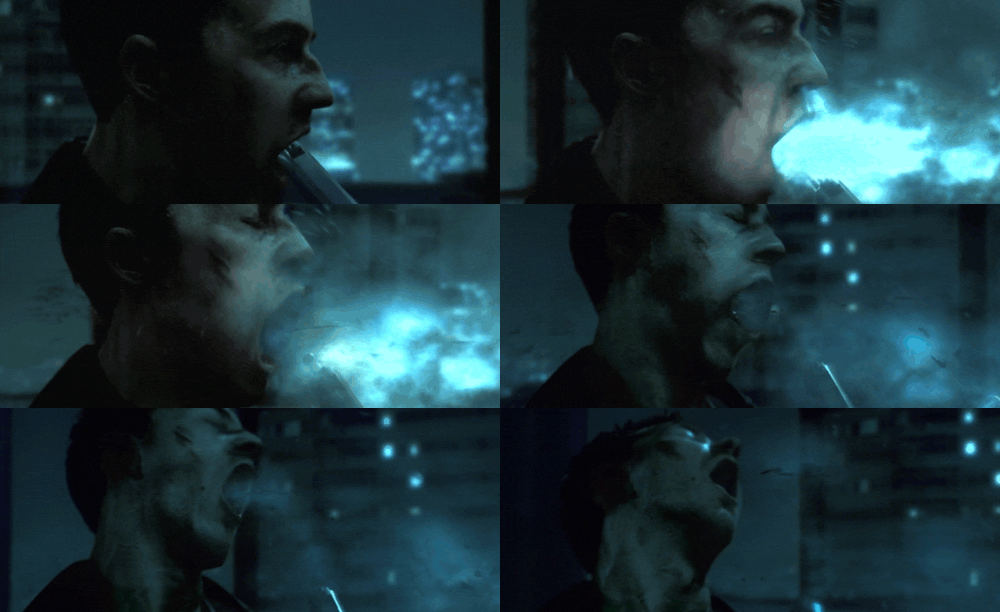
Brad Pitt and Edward Norton, Fight Club

The following is the next installment in a series of posts which began with the piece, Half Guilty.

One afternoon in October 1980, a 39 year-old man entered the Royal Melbourne Hospital suffering from a self-inflicted gunshot wound to the head. Doctors were able to extract .22 caliber bullet fragments from the man’s left frontal lobe and evacuate a intracerebral blood cot, saving the man’s life. Over the next few days, the man’s condition improved and doctor’s were able to interview him. Doctor’s would later diagnose the man with schizophrenia. It was signficant that two years prior, the man’s wife died in a car accident in which he was the driver.

The man described having a second head on his shoulder that would antagonize him at night. He believed the head belonged to his wife’s gynecologist, who, he suspected, his wife was having an affair with prior to her death. He claimed the head belonging to the gynecologist was trying to take over his body by dominating his normal head. Additionally, he said that he could hear the voices of Jesus and Abraham conversing with each other. These voices were confirming that he did indeed have two heads, while the gynecologist’s head had been telling him that it was the “king pin” and that it was going to take his wife away from him.

After three weeks of nightly torment from his phantom head,  the man decided to do something about it. He first considered removing the second phantom head with an axe. But with the proximity of his own head to a swinging axe blade, he chose a different tact. The man fired six shots in total, the first at the phantom head. The man thought the first bullet nearly took the second head off, leaving it hanging by a thread. He fired the second bullet through the roof of his own mouth. He then fired four more shots, one of which appears to have gone through the roof of his mouth and three of which missed. He said that he felt good at that stage, and that he could not feel the other head any more. He then passed out.

During his interview with doctors the man explained his motivations for his unorthodox behavior:

“The other head kept trying to dominate my normal head, and I would not let it. It kept trying to say to me I would lose, and I said bull-shit. ‘I am the king pin here,’ it said and it kept going on like that for about three weeks and finally I got jack of it, and I decided to shoot my other head off.”

Years later, the man was admitted to the hospital again, suffering from seizures as a result of alcohol abuse. Doctors interviewed him about his previous psychological delusions:
Q. Could you see the other head?
A. Yes.
Q. You felt it, or you could see it?
A. I could see it.
Q. And the voices were coming from the other head?
A. From that head and my own head too.
Q. Whose voice was it?
A. It was the voice of my wife’s doctor.
Q. What was he saying to you?
A. He had an affair with my wife and he reckoned he was going to take her off me and all that kind of talk and I got antagonistic towards him and I decided to do something about it and I shot myself.
Q. Since that episode have you had anything like that?
A. Not really. I have not heard any voices for about two years, ever since I shot myself and I haven’t had any ideas that I have two heads again. When I shot myself it fixed it up.

Via David Ames, Self Shooting of a Phantom Head, British Journal of Psychiatry 145:193-194 (1984).

First Circuit Says Right to Film Police in Action Protected Under the First Amendment

Simon Glik was arrested for shooting this footage of police arresting a suspect after a car accident.

Glik was charged with criminal violation of the Massachusetts wiretap act, aiding the escape of a prisoner and disturbing the peace. On appeal the First Circuit Court upheld the lower court’s ruling that, yes, “in the First Circuit . . . this First Amendment right publicly to record the activities of police officers on public business is established.”

Additionally, the Court went on to add, “Gathering information about government officials in a form that can readily be disseminated to others serves a cardinal First Amendment interest in protecting and promoting ‘the free discussion of governmental affairs.” Your rights [in the First Circuit] are safe for another day.

Via the Citizen Media Law Project.